01What it does
SAIKER is an agentic trip tracking system built for flight operations. It monitors every trip from planning through arrival, identifies developing issues as conditions change, and brings them to the attention of the right people while there is still time to act.
Each trip is evaluated against live flight data, weather forecasts, regulatory and international operating requirements, and the department's own procedures, so that every decision is made with a complete picture.
02The operational challenge
A revised forecast, a new restriction or a change in schedule can affect the aircraft, the crew and every leg that follows. Keeping the picture current has traditionally meant checking schedules, weather, notices, manuals and messages by hand, then deciding what deserves attention.
SAIKER carries that work forward between reviews, adding a continuous layer of verification to the oversight a department already has in place.
A living flight risk assessment
- 12
- A dispatcher checks twelve sources, most in separate tools, to confirm one leg is still sound.
- 24/7
- Much of the watch happens overnight, with one person on duty.
- 05.28.27
- Part 135 operators must have a Safety Management System in place by this date.14 CFR Part 5, 89 FR 33068
03How it works
01
Watch
SAIKER evaluates each trip as conditions change, against live aviation data and the department's own schedules, crew and procedures.
Need a decision
8
Not visible
0
In the air
3
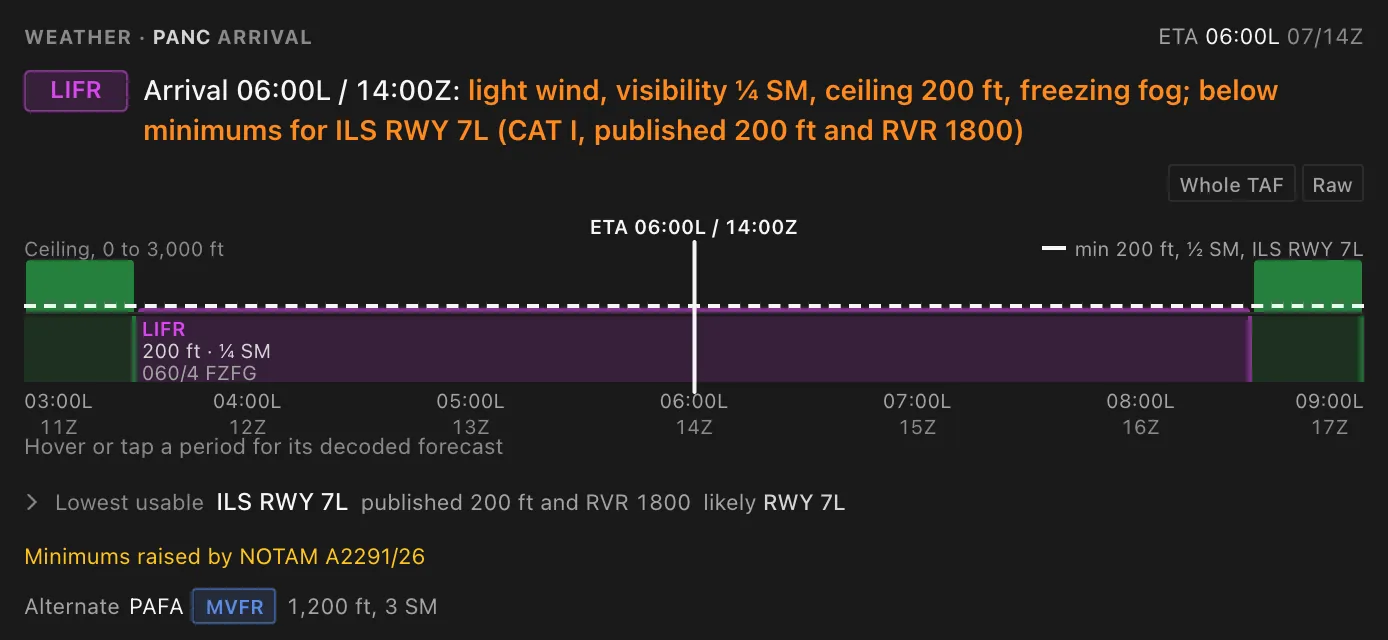
Anchorage forecast: 200 ft and ¼ mile in freezing fog at the 06:00 local arrival
19:58Z · Weather · re-checked T-2411
02
Explain
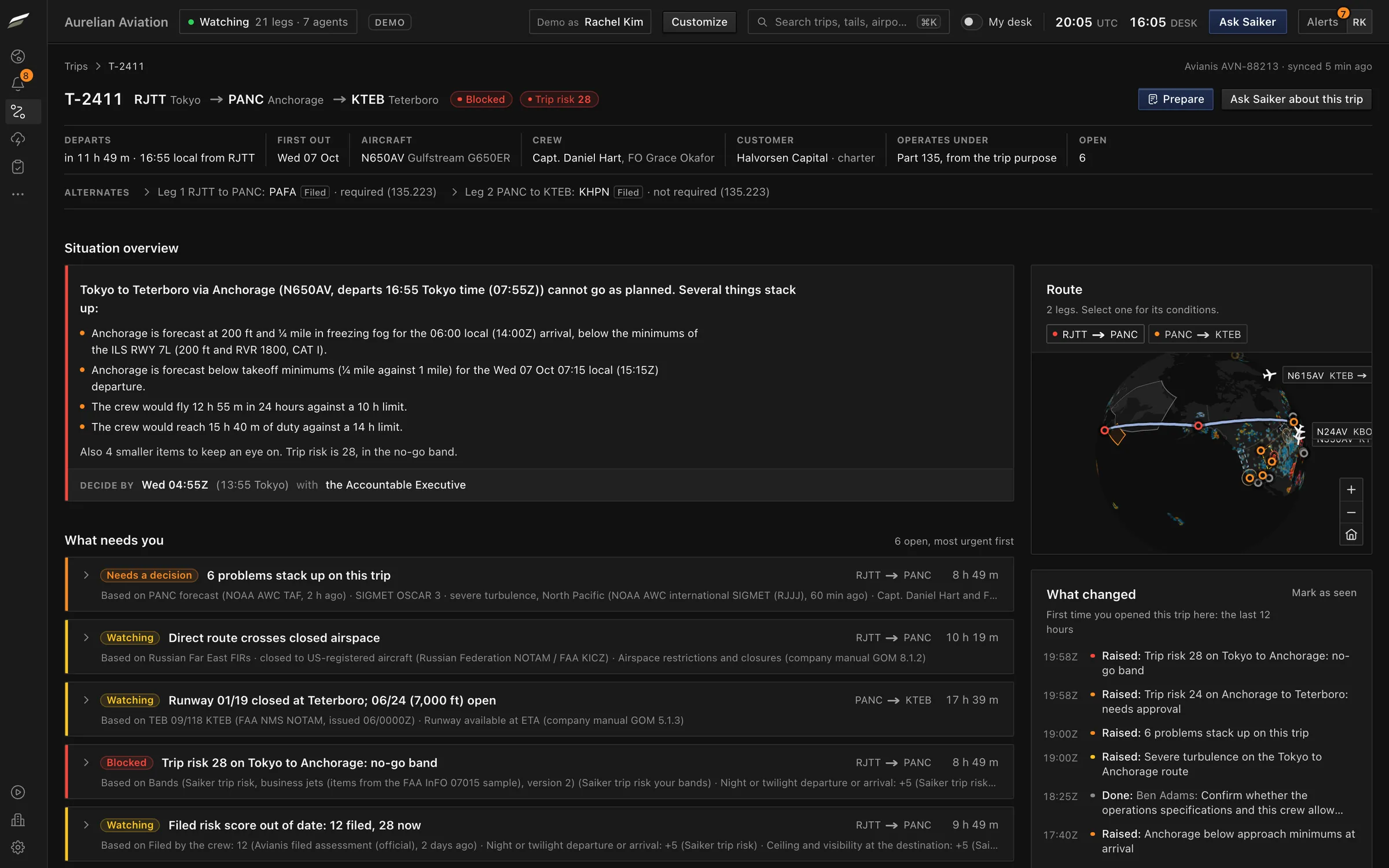
When something requires attention, it explains what changed, which flights are affected and why, with the evidence linked.
Tokyo to Teterboro via Anchorage (N650AV, departs 16:55 Tokyo time) cannot go as planned. Several things stack up:
- Anchorage is forecast at 200 ft and ¼ mile in freezing fog for the 06:00 local arrival, below the minimums of the ILS RWY 7L (200 ft and RVR 1800, CAT I).
- Anchorage is forecast below takeoff minimums for the 07:15 local departure.
- The crew would reach 15 h 40 m of duty against a 14 h limit.
Based on
- PANC forecast · official weather, 2 h ago
- ILS RWY 7L · published chart, current cycle
- Crew duty · your schedule, trip 88213
- Trip risk · company bands
03
Decide
A named person decides from clear options and a checklist, and SAIKER records who decided what, when and why.
Move the departureRecommended
Retime so both ends are in daylight; Anchorage is forecast to lift after 08:30 local.
Change the alternate
Fairbanks (PAFA) is forecast at 1,200 ft and 3 miles at the arrival time.
Swap or add crew
Add a pilot or split the day at Anchorage to stay inside 14 h.
Take it to the DO
Trip risk 28 is in the no-go band; the Director of Operations decides with the PIC.
- Confirm the new departure time with the client
- Tell the handler at Anchorage the new arrival
- Check crew rest at Anchorage for the second leg
- Record the decision and who made it
PendingRachel Kim · Move the departure · 20:14Z · reason and options kept for the safety file
04The prototype today
A working prototype runs today with read-only connections to scheduling systems. The screens shown here come from a demonstration operator.
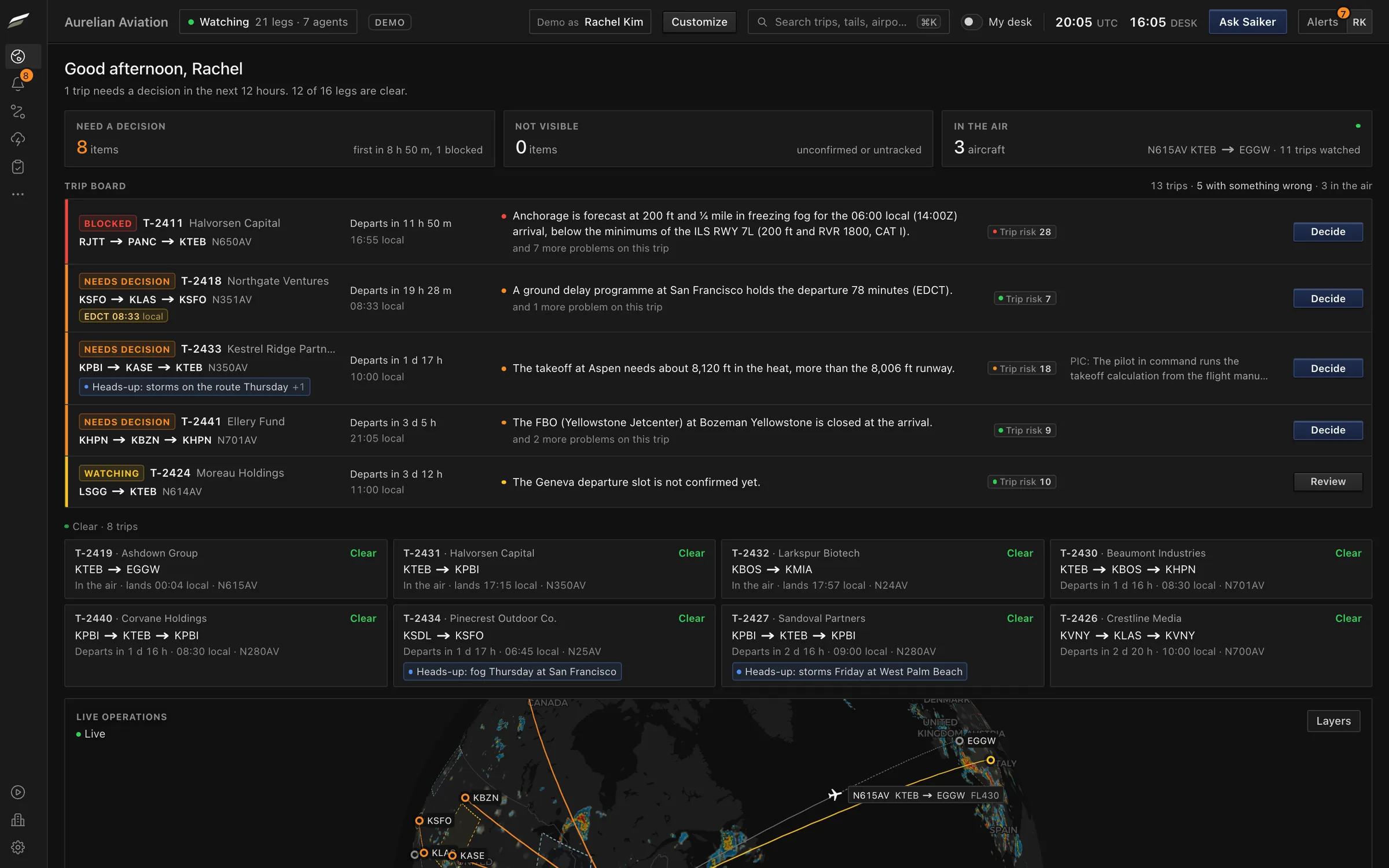
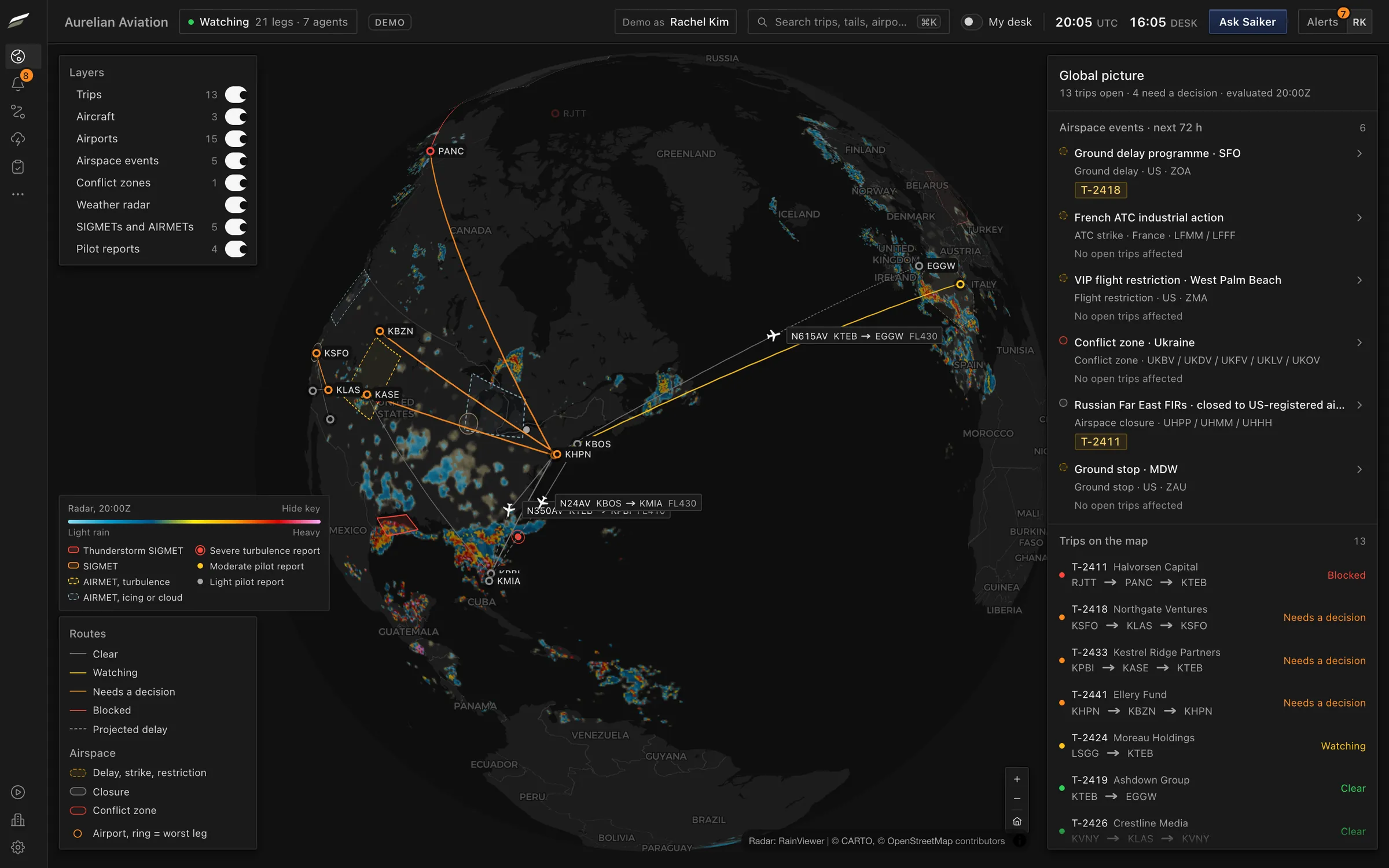
Every trip appears on one board beside the live map, colored by what requires a decision.
05Trip preparation
Prepare runs SAIKER's checks on a trip and opens a single trip sheet, with each item verified, flagged or plainly marked as not checked, so the team always knows where the trip stands.
Preparing
T-2411 Tokyo to Anchorage to Teterboro
0 verified0 flagged0 not checked
- Schedule and timesChecking.
- Aircraft, range and seats.
- Crew duty and qualifications.
- Weather at each end.
- Approaches and published minimums.
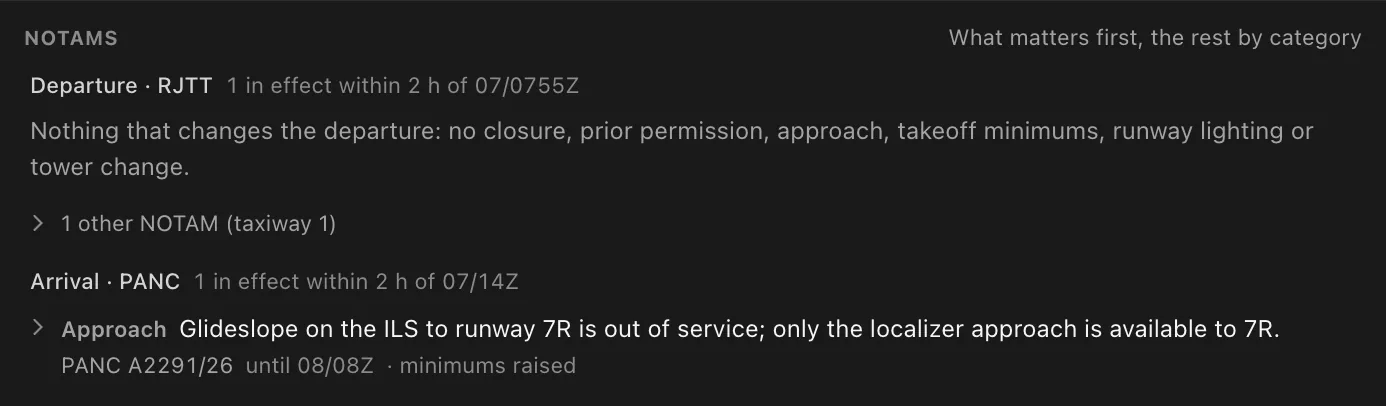
- NOTAMs.
- Airspace and conflict zones.
- Curfews, airport hours and customs.
- Slots and flow programs.
- Alternates under the operating rule.
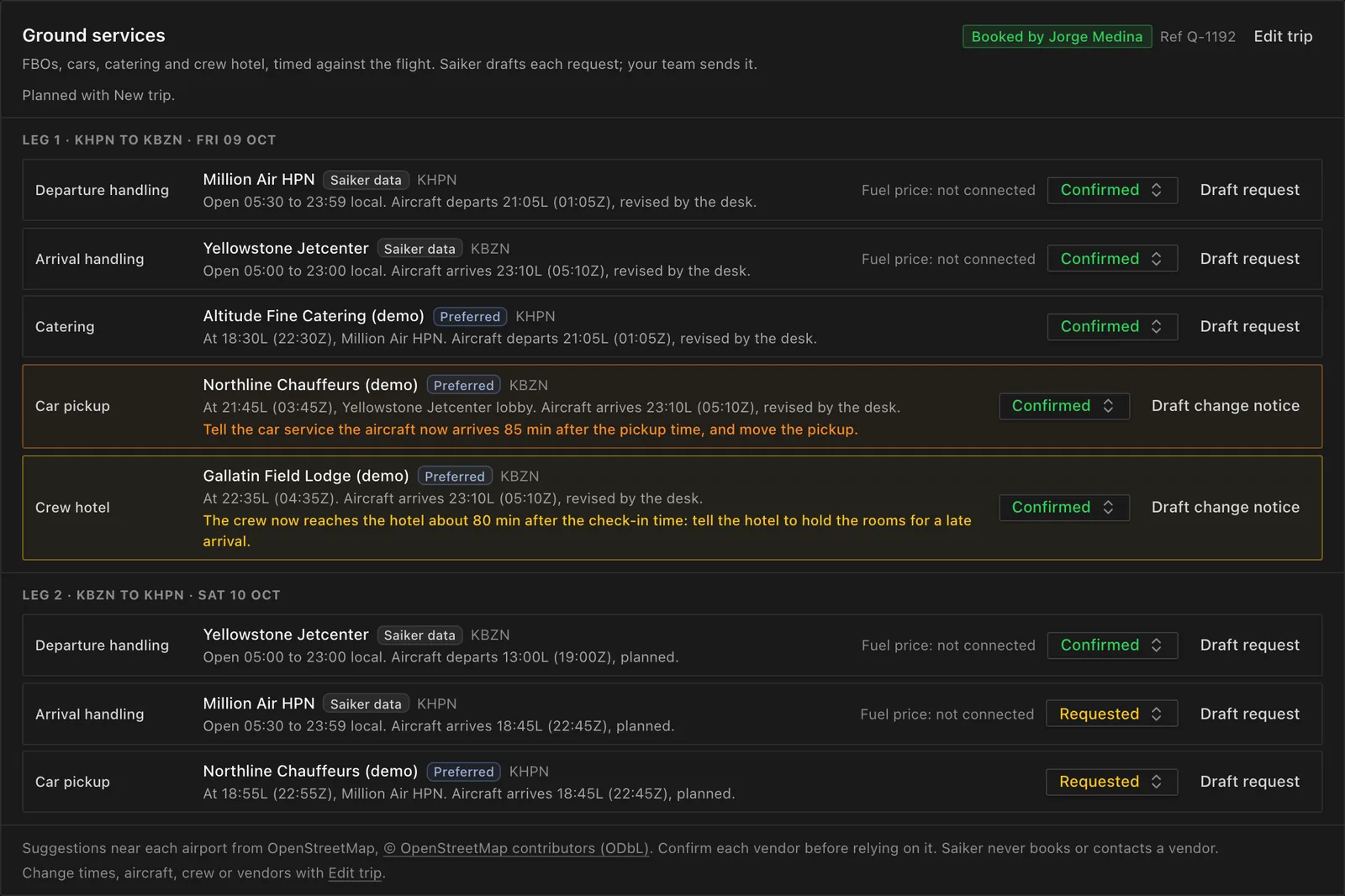
- FBO and ground services timing.
- Trip risk.
Every row is Saiker's real result for this trip. A check Saiker could not make says so.
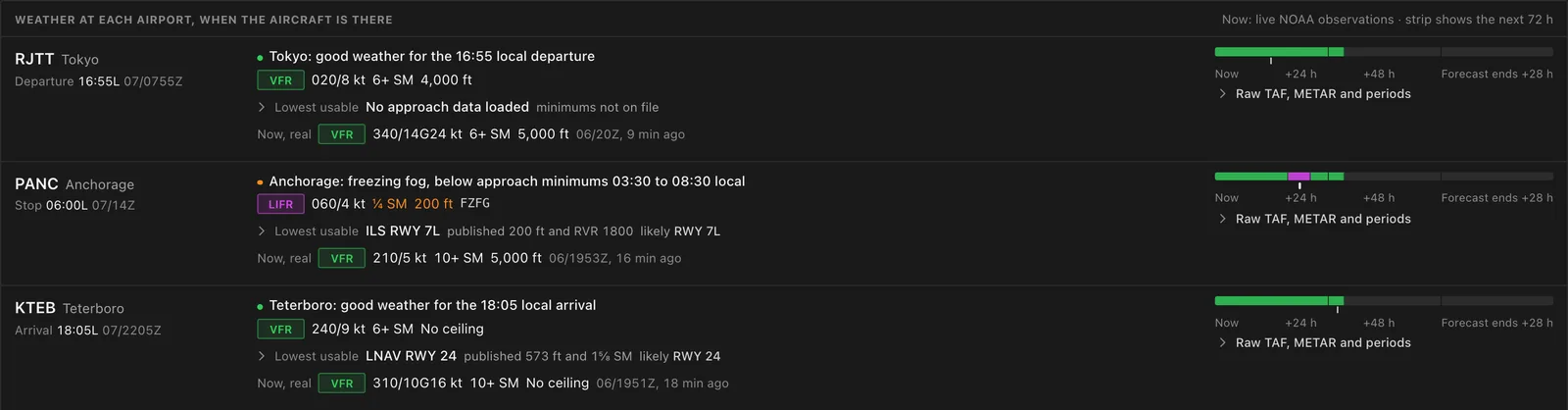
Weather at each airport
NOTAMs that affect the leg
Timed against the flight
06From signal to operational impact
A forecast, a schedule and a procedure usually sit in separate systems. SAIKER evaluates them together, so the effect of a single change is understood across the entire trip.
Ground delay program at San Francisco for low cloud
Inbound aircraft running late
Morning fog forecast at the destination
Severe turbulence advisory on the route
Arrival near customs closing time